Monday, 10 February 2020

FPW Ambulance Part 2 - S range Casualties and make your own FPW Ambulance

Not sure if it is to do with my condition and the frequent trips to hospital but I seem to have become a bit fixated on Ambulances!  

The more I looked at the anniversary model of the British Red Cross FPW ambulance, the more obvious it was that it was merely a standard Lledo standard model with transfers.  I therefore went on Ebay and found 2 Abels of East Anglia Bros models unboxed and with no drivers being offered for 99p plus 2.90 P&P.  I put in a bid of £1.00 and won them for 99p.

I created a template for the windows based on the original FPW ambulance and cut it out of an old Christmas card.  Easier to cut than cereal packet and thinner.  I have included all the measurements if you want to give it a go yourself.  You will need some extra lengths of 3mm wide strips of card to run along the plan front face of the model, you just line these up with the window frame and one at the bottom edge. I use Evostick wood glue to fix the card to the model.

Red Cross Original
My Conversion of Abel's Wagon still to fit reins!

Drivers.
I am not entirely sure where I got my model Minifigs carriage and passengers, but you can buy just the passengers who I have converted into drivers, limber riders etc.  There are 2 different models; WAGX3 is 2 British Napoleonic Officers – Open coach and WAGX4 two French Officers  - Open coach.  Needless to say for my purposes it was off with their heads.  I sacrificed one to make a seated figures for the Foundry Prussian gun.  For that exercise I didn’t take that much care separating the 2 figures using snippers to cut them apart and losing the arm of one of the figures in the process.  Sensibly, I never threw that part away and he has made an appearance as a Prussian cuirassier casualty (see below).

With a bit of effort with a scalpel, some emery paper and a file I was able to separate to two figures completely without damaging either and this gave me two drivers, albeit one looks like he is signalling a right turn!


Since then looking at the Minifigs 25mm on line catalogue, I came across a picture of a Russian Wagon driver in fatigue dress RNX1.  I have ordered 2 of these in the hope that, whilst they are not S range, they don't look as if they are modelled on the same lines as the more bulky 'Minifigs'.  In which case I (and you dear reader) may be able to be able to do a simple head swap without all the cutting about.   

From the various illustrations on line, 'uniforms' for these ambulance drivers and staff seem to be crosses between civilian and military uniforms, so it is a bit of free for all.  I stuck with the British blue uniform for the drivers but somehow managed to give them new heads with Kepis which, when I painted them, left them looking a little American Civil War-ish.  May change them. 

Casualties
Having created these ambulances (why does anyone need 3?)  I felt there was a need for some casualties to place around them.  It was back to my scarp box and collection of headless and arm less figures.  Starting with the French General mentioned above.  I drilled and bent a bit of florist wire so he could rest on the ground and then moulded some green stuff around the wire to give him an arm.  No matter how many times I use this compound I am hopeless with it!  The arm is too thick but after a lot of unsuccessful fiddling I gave up and decided that paint deceives the eye!  I gave him a Prussian Cuirassiers head which saved me having to do too much alteration to the body.


The other figure I had a lot of was the FPW artillery man with shell.  Probably the easiest figure to work with.  I literally cut away the base with my metal cutters and then filed to remainder back to the figures boots.  File away the shell and you can just leave it at that.  His hands are clutching his stomach.  I felt I wanted to reposition his left right arm so using my hand drill I drilled a series of holes to help me get a scalpel into position to cut the arm free.  A tip here,  drill through the arm at the shoulder into the body first as this helps to reposition the arm later.  Separating the arms also allow you to create a sling on the arm left attach to the body. 


If you are really feeling adventurous you can use exactly the same figure to make a sitting pose.  I merely cut the legs away from the body again using my cutters and filed things smooth; super-glued it onto a base and filled the gaps a little more successfully with green stuff.  Again I gave him a sling made of cooking foil.  

A very simple conversion using this figure is to remove the base; file back to the boots; file away the shell;  file the back flat and fix it to a base.  


You can cover the figure with a blanket made of cooking foil, or ‘cigarette paper’ or a piece of old rag if you fancy it.

Feeling really cocky,  I decided to try to make some walking wounded.  I was going to try to use the same figure and attack it with a soldering iron but my nerves are still not up to it.  So I had look at my spares and wondered if I could us a cavalryman?  After all he has two legs and they are sort of at a stride.  So again, out came the metal cutters and my large and small files and some emery paper to remove the saddle cloth etc.  I drilled his arm at the shoulder as described took it off and repositioned it.  I squeezed the legs together a bit with a pair of pliers and bent one back, again with pliers, to give the appearance of a walk.  I was going to get rid of the sword and give him a cane to rest on, but the sword gave me instance balance on the figure so I left it.  Again, the figure is clutching the reins , i.e his stomach.  To disguise this I gave him a sling.   I padded out the gap between the legs with green stuff.  I started with a Bavarian Cavalry head but thought it didn't work with the body.  I should stress that all the tools I used are very crude and easily available at any DIY store and may also account for the end result being not perfect.


 So I swapped for a French Hussar's busby head.  


Fortunately, the French Hussar model has ‘baggy trousers’ not sure I could do it with tight fitting cuirassier leggings, but I am going to give it a go as I sort of fancy a 'personality/command ' stand with perhaps a dismounted and mounted officer set up.  

So my original project has grown!


What is even worse is that I have come across some pictures of Ambulances in the Crimea War!!  In particular Dr. Smith's New Hospital Wagon.


By courtesy of the Welcome Foundation (CC)
This may be a step tool far!

Sorry about some of the pictures, my camera has developed a fault which I can't clear and will probably need to go back to Sony for repair.

Friday, 24 January 2020

Battle of Chongzhou: - a mostly Jacklex 20mm game


When I first got my diagnosis of cancer and was given ‘months’ I thought it was time to have a sort out of the figures and down size.  Jack had made me a number of ships over the years which were really great but difficult to sell on line because of their fragility and subsequent packaging.

I contacted gamers who I had been in touch with over time to see if they were interested in the models and more importantly could they physically collect them from my home.  Payment was a voluntary contribution to Cancer Research UK of what they thought the models and figures were worth.

One gamer Richard Wells came up from Kent to collect some ships and other bits and I have stayed in touch with him and his progress towards getting his table sorted out.  I am delighted to say that the models have finally hit the table and Richard has kindly sent me some pictures and a description of his game which he has agreed that I can post on my blog.

So I give you the Battle of Chongzhou:


A British force under the command of General Wells were instructed to relief a German and French force, running out of supplies and tied up in a fort next to the River Sonlung very close to the Chinese held town of Chongzhou.


First the much larger Chinese navy had to be defeated, before a dangerous landing could be attempted. The British navy consisted of HMS Daring and HMS Endeavour and a machine gun armed launch. Against them were arrayed 6 Chinese junks and 3 smaller dhows. Alas the Chinese navy proved no match for the much better armed British boats and after some extraordinary dice throwing the entire Chinese fleet was sunk in 3 moves, with very little damage to the British ships.


Landing boats with the Marines were then launched to make a bridgehead.


The Chinese commander  General XunTsu realising it was imperative to stop the landing sent all his cavalry and a unit of boxers to drive the Marines back into the sea before they could establish the bridgehead.

Richard's son Sebastian looks on as the Marines land.

The Marines and their Gardner gun only had time to clamber out of their landing craft and fire one volley before they were hit by the charging Chinese cavalry. That one volley managed to sweep away nearly half of the Chinese cavalry at close range but the charge was carried through and the Marines were beaten back into the sea, although they caused much damage to the cavalry, which was also forced to retire and re-group.


Two Highland regiments were fast approaching the shore, while the Boxers were closing in on the beach. The Marines in a dis-organised state were driven back a second time into the Scots whose firepower made some holes in the Chinese attackers. The Scots managed to land and the Boxers after one round of fighting fled.


Meanwhile the Germans and the French, despite being low on rations decided to launch their own  attack on Chongzhou - a risky operation at best. Chinese fire from the perimeter houses was highly inaccurate, as it was prove to be throughout the battle. The French and Germans fought their way through the houses forcing the Boxers into the open, but they had not realised that a unit of the crack Tigermen were waiting on the other side. These charged forward and despite loses forced the French and Germans back with their own heavy loses.


The patrol boat that General Wells had sent up the muddy river was now approaching the fort and relief was at hand. The British infantry started their advance on Chongzhou with a regiment of cavalry in support. The Navy’s ships poured fire into Chongzhou taking a particularly heavy toll of the Chinese gunners and guns on the battlements.


The regrouped Chinese cavalry decided to give it one more go and moved forward to meet the British cavalry. In a battle that seesawed backwards and forwards the British Cavalry eventually got the upper hand although both Cavalry forces were forced to regroup after 2 rounds of combat.


A small force of German snipers who had been ashore on the right side of the battlefield had now advanced within range of the town’s fortifications and started to lay down a withering fire.


While the Germans and French were fighting in Chongzhou, a small group of Chinese attacked the fort and one of them managed to force his way in killing the last French soldier.


Unfortunately for him the naval launch had by now arrived at the fort and it’s commander plus one rating confronted the Chinese and killed him after 2 rounds of combat.


Things were looking grim for the Chinese commander, so he decided to launch an attack against the German snipers


 His artillery were hopelessly inaccurate and were starting to take hits from both the naval launch’s machine gun and the approaching British infantry as well as a well placed German artillery piece which was firing from the fort. The Chinese stormed out and managed to finish off the remaining Germans before turning their attention to the Navy’s Gardner gun, which had started raking the city’s battlements. Despite taking what they thought was good cover they were mown down by the Gardner gun in two rounds of deadly fire, failing to score a single hit themselves.


General Wells now decided to go for the kill and sent his remaining Cavalry and himself up to the City’s main gate, armed surprisingly with previously unknown explosives. They received casualties from the Chinese defenders, but were able to lay the charges and then detonated them successfully. The Chinese commander realised the situation was now utterly hopeless and was forced to surrender.


I think we will be having a review of the rules next time to ensure the allied force do not have too many machine guns and artillery as these were an overwhelming factor in their victory. Although this was combined with some exceptional rifle fire by the British and a worse than expected performance by the Chinese infantry. In hand to hand battle they generally did quite well, but in a gun battle they were beaten every time.

However, it was a very enjoyable game and the buildings looked magnificent.

Most of the British figures are Jacklex 20mm available from Jacklex Miniatures  https://www.jacklexminiatures.com/ .  The Boxers are mainly plastic figures from Orion, there are also some 20mm metal figures, including the Tiger Men but the make is unknown. 


Tuesday, 7 January 2020

Conversion of Franco Prussian War ambulance for 25mm S range


Not being in the right mind set to start a new project as such I have been tinkering around. I read about the British Ambulance service in the Franco Prussian War.  This was a volunteer service funded by public and private donations. 

In 1991 To commemorate the Service the British Red Cross launched a ‘limited edition’ model by Lledo of a Horse Drawn Ambulance as used in the Franco Prussian War.  I picked one up on Ebay for a couple of pounds.  Whilst it is said to be carefully recreated from material held in the British Red Cross archives, the model owes much to the Lledo models used for other commemorative and publicity models.  I decided to use this as the basis for a model of a Franco Prussian War ambulance just to pass the time and keep my hand in at doing some S range conversions.


I used the material I had to hand.  Foam board and cardboard and it tuned into a bit of a dog’s dinner.  I struggled with the wheels amongst other things and decided to abandon the idea. 


One of the reasons for making my own version of the ambulance is because the rear wheels on the LLedo model are all wrong based on all the line drawings of the time.  But having made a hash of my own model,  


I went back to the Lledo model which was very ‘flat’ in terms of detail and decided to add strips of cardboard to give if a bit of depth.  


I also decided to get rid of the ‘universal driver’ which Lledo use on all there models substituting it for an S range conversion I made.  I was going to use a Prussian figure but then remade it with a British ‘cap’ more in line with the description I was able to find on line.  The horses had the usual LLedo ‘bobbed tails’ and poorly defined manes so I used a bit of ‘green stuff’ to make the tails and manes a bit more distinctive. 


I couldn’t find anything about the colour of these vehicles.  I didn’t like the ‘creamy yellow of the LLedo model and so opted for a more ‘wooden look’.

Lastly I drilled through and added some ‘cotton reins’.  Why I don’t know, but threading the cotton through the drill holes was an absolute pig.  These I ran back to the ‘driver’s’ hand and added a whip in his other hand for good measure.  


I then made up a couple of foot figures again I am not sure why.  The ‘officer’ is a Prussian gunner officer with a British head’.  The uniform is supposed to be based on the British artillery undress uniform.  The ‘Nun’ is made from the S range CR10 Nap Camp follower with bottle & bag.  I just filed down the hair to give a flat surface for what looks a bit like a ‘wimple’.


I decide not to put the ‘Service of the English Ambulance’ logo on the side so it was a bit ‘more open’ to who and where it was used but I made up wording in the right size to retro fit if needs be.  

Anyway it is just a bit more nonsense and passed the time. May even go back and try to rescue my early attempt!


Saturday, 21 December 2019

The Last Christmas Post

Well this is a busy week for me, what with Christmas, my birthday on the 29th and then our wedding anniversary on 30th December, swiftly followed by the New Year.

By common consent this looks like the last of these I will see, but you never know I didn't expect to get this far.  I will keep posting and gaming for as long as possible, it would be great to reach the spring.  I would however, like to take this opportunity to thank you all for your good wishes and encouragement over the recent months.  I can assure you they have been greatly appreciated and uplifting.  

I have really enjoyed running this blog and our sister site 'All Things Jacklex' and taking pictures (maybe too many on occasions)  and it has been a source of some pleasure that so many of you have enjoyed them.  You will have to put up with them a little while longer!

So a very Merry Christmas to you all and a Happy New Year.

Wednesday, 18 December 2019

Some extracts of the aftermath of Waterloo written in 1817

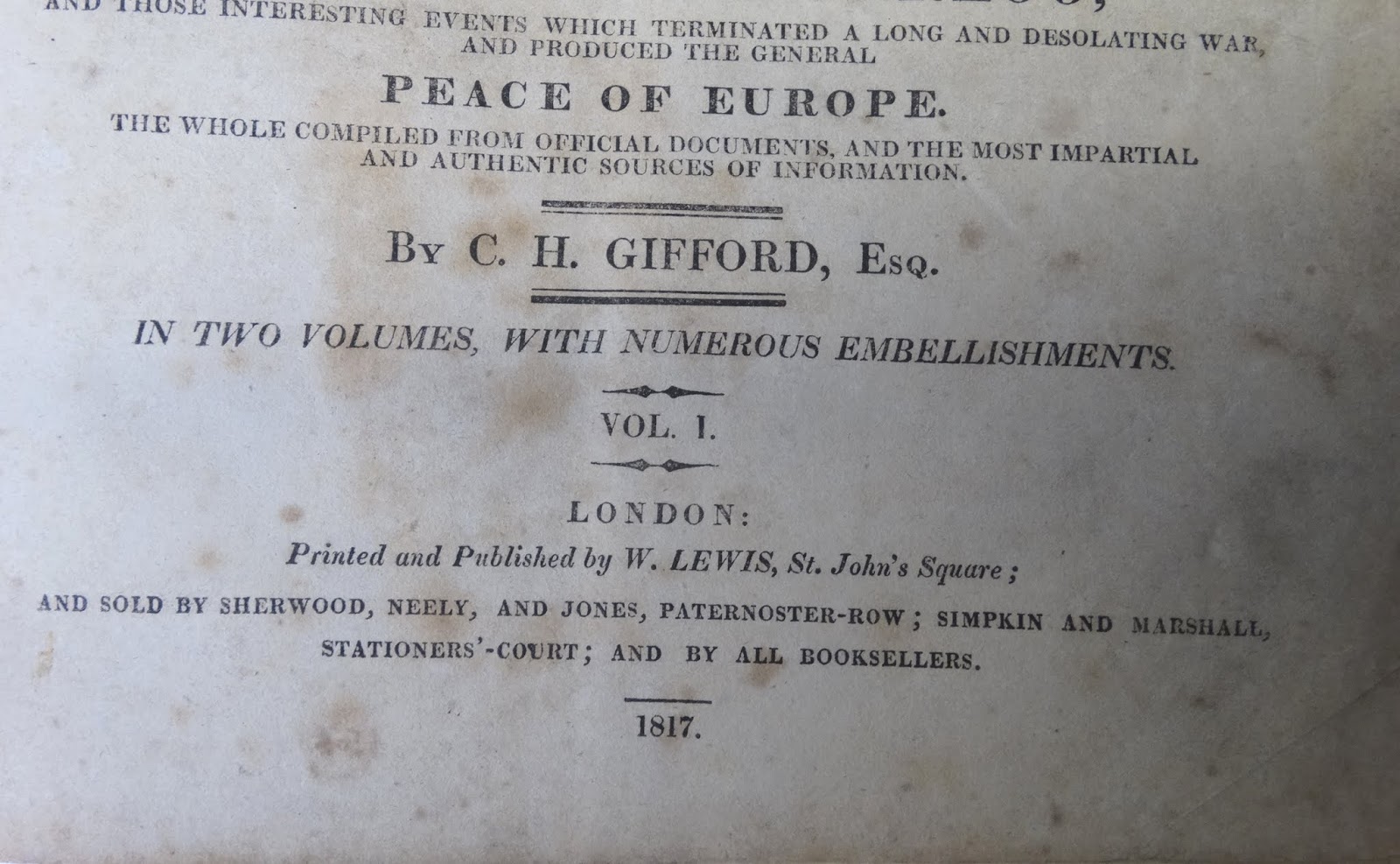
About 25 years ago or so I bought 2 volumes of the History of the Wars from a second hand book shop in the Charing Cross Road in London.  The spines were in a poor state and the covers were detached on both volumes.  But they were printed in 1817 and contained amongst a host of other things, first-hand accounts of the Battle of Waterloo and unusually, the aftermath.


I promised myself that I would get them bound and repaired and they sat on the self and I would open them to get information on naval engagements were I would find ships names, captains and number of guns and crew. 

Finally, even though I have the big ‘C’ I decided to get them bound as a last Christmas present to myself.  I managed to find a bookbinder in a small town outside of London who wasn’t going to bankrupt me for repairing the books and was enthusiastic to work on them.


I now have them back and thought I would share some extracts of the aftermath of Waterloo which perhaps we are inclined to overlook. 


Although these are accounts of Waterloo they probably hold true for many of the battles of the early 19th century where warfare involved large numbers of troops.  These are just a few of the many descriptions.  The numbers may or may not be right but again come straight from the books.

‘The field of battle the next morning presented a most melancholy sight.  About 45,000 dead all of whom had been stripped naked and perhaps the same number of wounded whom as yet it had been impossible to remove lay crowed in a narrow space.  Near 25,000 horses, dead or wounded lay mixed with their former riders and increased the horrors of the scene.  It was not so much the ghastly wounds which had deprived them of life which disfigured them their mangled remains.  But these had been further trampled by the cavalry, crushed by the artillery and torn to pieces by the continued showers of bullets vomited forth over the positions.  The number of dead upon the field of battle, said an eye witness could not be numbered.  It presented on the 19th, said one who saw it, a spectacle like an army asleep.’

It continues

‘For many days several thousand carriages, and many peasants from the surrounding countryside, even as far as Mons, were employed in burning or burying the dead.  The task was not only loathsome, but dangerous and the Prussians were absolutely forced to compel them at the point of the bayonet.  To avoid infection from the corrupting remains, the peasants first dug large pits, and then, by means of large hooks, dragged the bodies into them.  The country for several miles, presented the appearance of one continued large groups of hillocks, so thickly was its surface covered with large graves in which hundreds of bodies of men and horses were thrown together. In one acre of ground a beholder counted 40 graves thus filled with dead’. 

‘The weather having become dry after the burial, the wet mould, which had not been thrown over them to sufficient depth cracked from the heat, and opening , shewed, in  some places their ghastly remains.’

‘Notwithstanding the burning and burying, the smell from their putrid carcasses was insufferable and a pestilential gale continued to be wafted over the surrounding countryside from this theatre of death.  For many days the number of carrion flies which fed on the dead bodies was dreadful and most annoying to those who visited the spot.’

‘It is said that some soldiers absolutely lost their reason from the remembrance of the dreadful scene’ (an early account of PTSD?)

At Houghmont every tree in the wood seemed as if blighted and were pieced with cannon-bullets.  Some were pierced with 20.  The branches were broken off and destroyed. Immense graves and dreadful heaps of ashes, the remains of burnt bodies, marked the fatal spot.  Broken swords, helmets, torn epaulets and sabre sashes, bathed in blood shewed how furious and destructive the battle had been here.  Mixed with these were seen the flaring red poppy, rearing its head among the fresh dug mould’.....’Soldiers caps, pierced with many a ball helmets, cuirasses, tattered clothes, cartouche boxes, military decorations, crosses of the legion honour.  French novels, German testaments, packets of cards, letters from lovers to the object of their affection, from parents to their children mangled bodies, legs, heads in helmets intended to protect them, and arms strewed in fearful confusion lay along these bloody fields’

The book also contains many letters and extracts from British Officers recounting their recollections of the battle.  Interestingly amongst these is the extract from a letter from Serjeant* Ewart of the Scots Greys who took the French Eagle. (*not a typo, the way it is spelt in the book)

‘The enemy began forming their line of battle about nine in the morning of the 18th: we did not commence till ten.  I think it was almost eleven when we were ready to receive them.  They began upon our right  with the most tremendous firing that ever was heard, and I can assure you, they got it as bad as they gave it: then it came down to the left, where they were received by our brave Highlanders.  No men could ever behave better: our brigade of cavalry covered them. Owing to a column of foreign troops giving way , our brigade was forced to advance to support our brave fellows and which we certainly did in style; we charged through two columns each about 5,000; it was on the first charge that I took the eagle from the enemy; he and I had a hard contest for it; he thrust for my groin – I parried it off and cut him through the head; after which I was attacked by one of their lancers, who threw his lance at me, but missed the mark, by my throwing it off with my sword by my right side; then I cut him from the chin upwards, which went through his teeth; next I was attacked by a foot soldier, who, after firing  charged me with is bayonet – but he very soon lost the combat, for I parried it and cut him down through the head; so that I finished the contest for the eagle.  After which I presumed to follow my comrades, eagle and all but was stopped by the general saying to me “You brave fellow, take that to the rear: you have done enough until you get quit of it:” which I was obliged to do but with great reluctance.  I retired to the height and stood there for upwards of an hour, which gave a general view of the field, but I cannot express the horrors I beheld; the bodies of my brave comrades were lying so thick upon the field that it was scarcely possible to pass and horses innumerable.  I took the eagle into Brussels amidst the acclamation of thousands that saw it’.

There are also accounts from Prussian Spanish and other observers at the battle as well of course of descriptions from both the British and French sides.  But these two volumes contain so much more in their densely packed text, the Battle of New Orleans; Nelson’s great naval battles as well as many more much smaller but important naval engagements; and the campaigns in Portugal and Spain.  My only question to myself is why didn’t I get them rebound and repaired years ago?